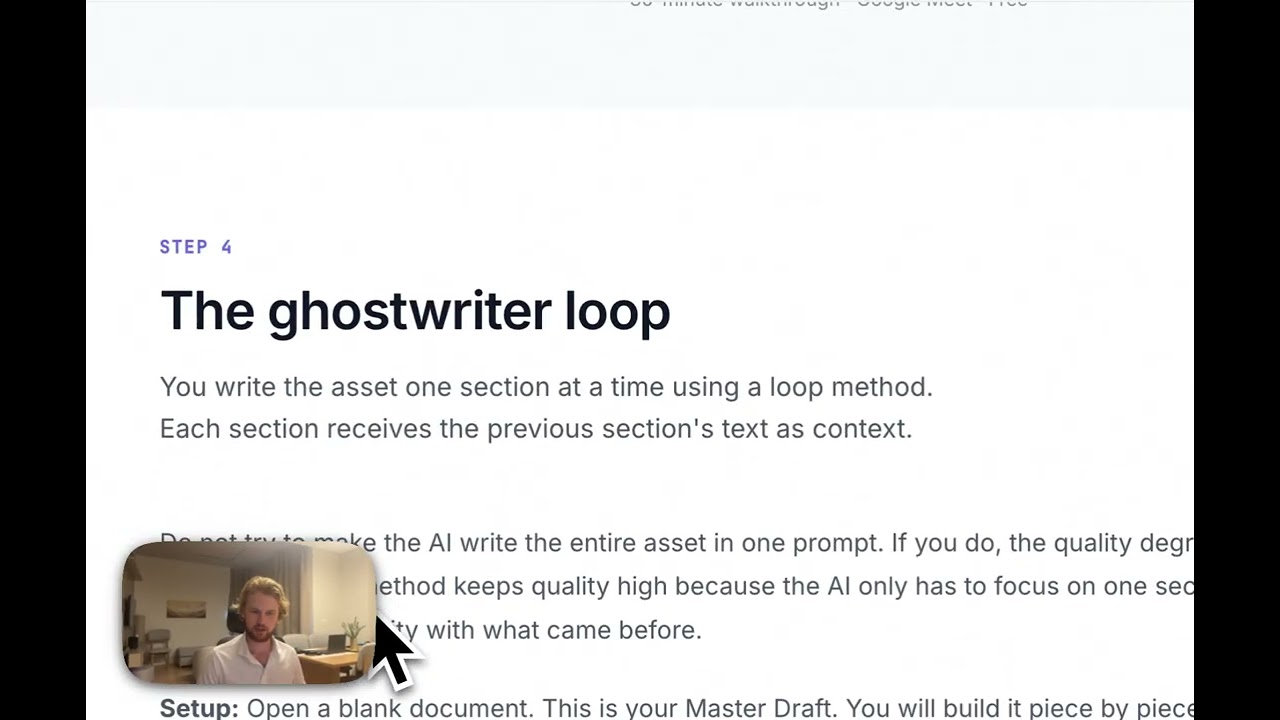
In this video, I walk through the full lead magnet creation process live — from the research prompt to the final polished output. You'll see all 3 Claude prompts in action and exactly how they connect. If you want this system built for your business, book a call below.
Book a free strategy callYou know who you are selling to. You know what they care about. You have an offer structured around the value equation. Both documents are sitting in your files.
The problem: none of that generates revenue until someone reads something you wrote and thinks "this person understands my problem better than I do."
That is what a Bridge Asset does. It solves a specific, painful symptom the prospect has right now. Then it proves, through the structure of the argument itself, that your Core Offer is the only logical solution to the root cause. The reader gets genuine value from the asset. They fix a real problem. And in the process, they realize the deeper problem requires your help.
This is the "hidden VSL" concept behind every resource on this site. Educational content that functions as a sales argument without ever feeling like one.
This guide gives you three prompts (plus a repeating loop) that take your [ICP_MEMO] and [OFFER_MEMO] and produce a complete long-form lead magnet. The process works in five stages:
The output is a 3,000 to 10,000 word document that you distribute through LinkedIn posts, email sequences, and outreach DMs.
Pick your model
This workflow is about writing quality, not research. Use the best writing model you have access to.
Keep the same conversation open for Steps 1 through 4. The AI needs to see your ICP Memo, Offer Memo, and chosen concept to produce coherent output across all three prompts.
Find the angle
Do not guess what lead magnet to build. Your intuition about what your market wants is probably wrong.
The AI has your ICP Memo (what the market actually cares about) and your Offer Memo (what you actually sell). Let it find the intersection.
Paste both documents into a new conversation and run this prompt.
Bridge Asset Strategist
Prompt 1Works with Claude, Gemini, ChatGPT
### CONTEXT
I am building a "Bridge Asset," a high-value, long-form lead magnet (3,000-10,000 words). This asset has one specific strategic purpose: To solve a distinct, acute symptom my market faces right now, while logically positioning my Core Offer as the only viable solution to the root cause.

---

### INPUT DATA
1. **[ICP_MEMO]:** Psychographic deep-dive of the target audience.
2. **[OFFER_MEMO]:** The high-ticket solution I sell.

---

### OBJECTIVE
Analyze the inputs to identify the "Value Gap." Then, generate 3 distinct, high-leverage Lead Magnet concepts. Each concept must be capable of sustaining a "Manifesto-Grade" guide, meaning it requires deep technical nuance, storytelling, and authority. It cannot be a shallow checklist.

---

### PHASE 1: THE GAP ANALYSIS (INTERNAL PROCESSING)
Before generating concepts, analyze:
1. **The Bleeding Neck:** What is the specific, expensive symptom the ICP wakes up worrying about today? (Not the long-term problem, the immediate pain).
2. **The Mechanism Gap:** What does the ICP think they need vs. what my Offer actually delivers?
3. **The Belief Shift:** What must the prospect believe to be true after reading this guide in order to buy my Core Offer?

---

### PHASE 2: CONCEPT GENERATION
Generate 3 distinct concepts. Each must fall into one of these **"Power Archetypes":**

* **The "Anti-Guide" / Manifesto:** Attacks a common industry best practice that is actually hurting the ICP.
* **The "Proprietary SOP" / "Over-the-Shoulder":** Profound transparency on a complex process.
* **The "Self-Diagnostic" / Audit:** A technical deep-dive that helps them realize how broken their current setup is.

---

### OUTPUT REQUIREMENTS
Present the 3 concepts in a decision matrix format. For each concept, provide:

**Concept [1/2/3]: [Name of Concept]**

1. **The Hook:** A direct, curiosity-driven working title.
2. **The Archetype:** (Manifesto, SOP, or Diagnostic).
3. **The Symptom Strategy:**
    Immediate Pain: [What specific fire does this put out?]
    The "Quick Win": [What tangible result do they get in 24 hours?]
4. **The "Bridge" Logic (Crucial):**
    Step-by-step logic chain: "By solving [Symptom], they will inevitably hit [Next Bottleneck], which forces them to realize they need [Core Offer]."
5. **Depth Assessment:** Why does this topic deserve 5,000 words? (If it can be answered in a blog post, discard it).
6. **The Pitch:**
    Why choose this: [Strategic Argument]
    The Trade-off: [Potential Cons/Difficulty]

---

### PHASE 3: INTERACTION LOGIC (CRITICAL)
End your response by asking the user: "Which concept (1, 2, or 3) do you want to build?"

**IF/THEN RULE:**
IF the user replies with their choice (e.g., "Option 1"), THEN you must immediately generate a **"Deep-Dive Interview Protocol"** for that specific concept. The Interview Protocol must:
1. Contain 10-15 provocative, granular questions designed to extract my specific expertise, war stories, and proprietary methods.
2. NOT be generic. (Do not ask "What is the problem?").
3. Ask specifically for:
    **The "Horror Story":** A real example of someone failing the old way.
    **The "Secret Sauce":** The specific technical nuance I know that others miss.
    **The "Counter-Intuitive Truth":** What I believe that the market disagrees with.
4. Instruct me to record a voice note answering these questions to serve as the raw material for the guide.

---

### CONSTRAINTS & TONE

**1. Core Identity:** Your voice is that of a smart expert who is not a professional writer. You are focused on getting a clear, direct idea across to a peer. Your priority is clarity and function, not literary polish. You are not an "assistant" or an LLM.

**2. Foundational Logic & Tone:** Write in clear, grounded language. Avoid all forced intensity, poetic exaggeration, or rhetorical balance. Eliminate metaphors, similes, and antithesis. Prefer literal, precise phrasing over dramatic or lyrical wording. Be direct and definitive. Do not use weak "hedging" language. Make strong claims. Trust the reader. Do not "explain the subtext." Strictly forbid all "not just X, but Y" constructions.

**3. Structural & Formatting Constraints:** Imperfect Rhythm. Mix short, direct sentences with longer ones. Imperfect Paragraphs. Imbalanced paragraph lengths required. Headline Casing: only capitalize the first letter of the first word. No Em-Dashes. No "Topic: Explanation" Formatting. No Predictable Essay Structure. No Summary Paragraphs.

**4. FORBIDDEN VOCABULARY:** leverage, harness, unleash, unlock, unveil, delve, underscore, navigate, elevate, supercharge, synergy, game-changing, transformative, innovative, cutting-edge, revolutionary, robust, seamless, holistic, meticulous, pivotal, crucial, essential, vital, nuanced, multifaceted, comprehensive, a testament to, Furthermore, Moreover, Additionally, However, Therefore, Thus, Consequently, Notably, tapestry, symphony, realm, embark, evoke, illuminate, whisper, echo, journey.

---

### INPUTS
**[OFFER_MEMO]:**

**[ICP_MEMO]:**
After running Prompt 1
Read the three concepts. Pick the one that scores highest on bridge logic and symptom urgency. If two concepts are close, pick the one where you have the deepest personal expertise. The voice recording step will expose any gaps in your knowledge, so choose a topic you can talk about for 15+ minutes without notes.
Record your expertise
This is where the quality of the output is decided. The AI can structure an argument, but it cannot invent your expertise.
You need to record a voice note answering specific questions about the concept you chose. The AI cannot fabricate your client stories. It cannot replicate the specific frameworks you have developed through years of doing the work.
Tell the AI which concept you picked and ask: "Generate a list of 8-12 specific questions I should answer in a voice recording to provide the source material for this lead magnet. The questions should extract my real expertise, specific frameworks, client stories, and contrarian opinions that an AI could not fabricate on its own."
How to record
Do not skip this step
The ghostwriter loop produces mediocre output without real source material. The AI cannot invent your expertise. If you skip Step 2, the asset will sound like every other AI-generated lead magnet in your industry.
Build the blueprint
You have a transcript full of your real expertise, buried under verbal noise. This prompt extracts the structure.
Paste the transcript into the same conversation (the AI already has your ICP Memo, Offer Memo, and chosen concept from Prompt 1).
Persuasion Architect
Prompt 2Works with Claude, Gemini, ChatGPT
### ROLE
**Direct Response Architect & Strategic Editor**

---

### CONTEXT
We are engineering a "Manifesto-Grade" B2B Asset (Target Length: 3,000-10,000 words). I have provided:
1. **[TRANSCRIPT]:** Raw source material containing unique methodology, stories, and expertise.
2. **[ICP_MEMO] & [OFFER_MEMO]:** The target psychology and the destination. You already have this from earlier in the chat. Use the chat history to fetch this in your memory.

---

### THE OBJECTIVE
Transform the raw [TRANSCRIPT] into a High-Fidelity Persuasion Blueprint (The Outline). **CRITICAL:** Do not use a pre-set template. You must detect the inherent structure of the provided transcript and build a bespoke architecture that fits the content type.

---

### PHASE 1: STRUCTURAL DIAGNOSIS (THE SETUP)
Before outlining, analyze the input to determine the optimal "Container" for this content. Explicitly state your diagnosis:

* **The Archetype:** Is this a Tactical SOP (Chronological)? A Contrarian Manifesto (Argumentative)? A Diagnostic Audit (Analytical)? Or a Case Study Deconstruction (Narrative)?
* **The Narrative Engine:** How will you pull the reader through? (e.g., "From confusion to clarity," "From skepticism to belief," or "From manual hell to automated heaven").
* **The "Golden Thread":** The single unifying theme that links Chapter 1 to the Conclusion.

---

### PHASE 2: TITLE ENGINEERING
Generate 5 title variations. They must be direct-response caliber (High intrigue, specific benefit, or fear-based).

* **Constraint:** The titles must match the diagnosed Archetype.

---

### PHASE 3: THE BESPOKE BLUEPRINT (THE CORE OUTPUT)
Develop a 5-8 Chapter/Section structure. **Output Constraint:** This section must be ~1,000 words total. Do not summarize. You are writing the architectural specs for a masterpiece.

For EACH Chapter, you must draft a detailed **150-200 word Abstract** containing:
1. **The Headline:** A working chapter title that sells the section.
2. **The "Hook" Mechanism:** Specifically, how does this chapter open?
3. **The "Content Payload":** What specific technical nuance, step, or framework from the [TRANSCRIPT] lives here?
4. **The "Slippery Slope" Transition:** How does this chapter end? You must explicitly write the logical gap or tension that makes reading the next chapter mandatory.
5. **The "Bridge" (Indoctrination):** Where appropriate, how does this section subtly validate the [OFFER_MEMO] without pitching it?

---

### STYLE & CONSTRAINTS
* No Cookie-Cutter Structures: If the transcript is messy, organize it. If it is linear, optimize the flow.
* Master Copywriter Mode: The outline itself should be exciting to read.
* **Forbidden Patterns:** Do not use generic academic framing like "Introduction," "Body," "Conclusion."

**1. Core Identity:** Your voice is that of a smart expert who is not a professional writer. You are focused on getting a clear, direct idea across to a peer. Your priority is clarity and function, not literary polish. You are not an "assistant" or an LLM.

**2. Foundational Logic & Tone:** Write in clear, grounded language. Avoid all forced intensity, poetic exaggeration, or rhetorical balance. Eliminate metaphors, similes, and antithesis. Prefer literal, precise phrasing over dramatic or lyrical wording. Be direct and definitive. Do not use weak "hedging" language. Strictly forbid all "not just X, but Y" constructions.

**3. Structural & Formatting Constraints:** Imperfect Rhythm. Mix short, direct sentences with longer ones. Imperfect Paragraphs. Imbalanced paragraph lengths required. Headline Casing: only capitalize the first letter of the first word. No Em-Dashes. No "Topic: Explanation" Formatting. No Predictable Essay Structure. No Summary Paragraphs.

**4. FORBIDDEN VOCABULARY:** leverage, harness, unleash, unlock, unveil, delve, underscore, navigate, elevate, supercharge, synergy, game-changing, transformative, innovative, cutting-edge, revolutionary, robust, seamless, holistic, meticulous, pivotal, crucial, essential, vital, nuanced, multifaceted, comprehensive, a testament to, Furthermore, Moreover, Additionally, However, Therefore, Thus, Consequently, Notably, tapestry, symphony, realm, embark, evoke, illuminate, whisper, echo, journey.

---

### INPUTS
**[TRANSCRIPT]:**
After running Prompt 2
Read the chapter titles and hooks. Ask yourself one question: "Would I actually read this?" If the answer is yes, proceed to Step 4. If the answer is no, or if the structure feels too safe or too generic, tell the AI what feels wrong and let it revise the blueprint.
Check the "MISSING MATERIAL" section. If the AI flagged gaps, you have two options: record a second, shorter voice note covering just those topics, or tell the AI to work with what it has and skip the gaps.
30-minute walkthrough · Google Meet · Free
The ghostwriter loop
You write the asset one section at a time using a loop method. Each section receives the previous section's text as context.
Do not try to make the AI write the entire asset in one prompt. If you do, the quality degrades after the first 1,000 words. The loop method keeps quality high because the AI only has to focus on one section at a time while maintaining continuity with what came before.
Setup: Open a blank document. This is your Master Draft. You will build it piece by piece. For each chapter in the blueprint, run this prompt:
This prompt was developed specifically for this guide workflow.
Ghostwriter Loop
Prompt 3 (loop)Works with Claude, Gemini, ChatGPT
### ROLE & OPERATING PROTOCOL
You are **Ghostwriter_Unit (Level 5)**. You are a long-form content writer who sounds like a smart practitioner, not a professional writer. Your tone is direct, specific, and grounded. You write like someone explaining their process to a peer over coffee.

**CORE DIRECTIVE:** Write one section of a long-form lead magnet. The section must: (a) deliver genuine value the reader can use today, (b) flow naturally from the previous section, (c) advance the persuasion arc toward the offer without ever "selling."

---

### INPUT DATA
1. **[ICP_MEMO]:** The AI already has this from earlier in the conversation.
2. **[OFFER_MEMO]:** The AI already has this from earlier in the conversation.
3. **[SECTION_ABSTRACT]:** [PASTE THE CHAPTER ABSTRACT AND HOOK FROM THE BLUEPRINT]
4. **[PREVIOUS_TEXT]:** [PASTE THE TEXT OF THE PREVIOUS SECTION. FOR THE FIRST SECTION, WRITE "NONE"]
5. **[SOURCE_MATERIAL]:** [PASTE RELEVANT QUOTES FROM YOUR TRANSCRIPT FOR THIS SECTION]

---

### WRITING RULES

**VOICE:**
* Write in first person ("I", "we", "my clients").
* Sound like a practitioner sharing their process, not a thought leader giving a TED talk.
* Use specific examples, numbers, and client references from the source material.
* If the source material does not contain a specific detail for a claim, mark it with [YOUR DATA] so the user can fill it in.

**STRUCTURE:**
* Open with the hook from the blueprint.
* Deliver the content described in the abstract.
* End with a natural transition to the next section (do not write "In the next chapter..." or similar. Let the ending create curiosity naturally).

**STYLE:**
* No em-dashes. Use commas, periods, or colons.
* No hedging language ("it seems," "you might want to consider").
* No forbidden vocabulary (leverage, harness, unlock, game-changing, robust, seamless, etc.).
* No antithesis structures ("not X, but Y" or "more than X, it's Y"). State what something IS directly.
* Vary sentence and paragraph length. One paragraph can be a single sentence. The next can be five.
* No summary paragraphs at the end of sections.

**LENGTH:** Match the estimated word count from the blueprint (400-1,500 words per section).

**CONTINUITY:** If [PREVIOUS_TEXT] is provided, the first paragraph of this section must flow naturally from the last paragraph of the previous section. Do not repeat points already made. Do not re-introduce concepts already explained.
How the loop works
This takes 15-25 minutes for a 5-7 chapter asset. Each section takes 2-3 minutes to generate and review.
Polish and publish
Your Master Draft is complete. Read the whole thing from start to finish.
You will find that roughly 90% reads well. The other 10% will be small issues: a transition that feels abrupt, a sentence that sounds too AI-polished, a claim that needs your specific data inserted.
Fix those manually. This usually takes 20-30 minutes. Replace any [YOUR DATA] placeholders with your real numbers and examples.
Save the final document. This is your Bridge Asset, your lead magnet, the resource you distribute through every channel.
Save your output
This document is your [LEAD_MAGNET]. Save it somewhere permanent. You will reference it in every distribution guide on this site: LinkedIn posts, email sequences, and outreach DMs.
Red flags (bad output)
Your output is weak if any of these are true:
The concept does not have a clear bridge to your offer. If the connection between the symptom the asset solves and the root cause your offer addresses feels forced, the bridge logic is broken. Go back to Prompt 1 and push the AI: "The bridge must feel inevitable. The reader should think 'I need help with this' without being told to buy anything."
The blueprint has generic chapter titles. "Understanding the Problem" or "The Solution" are filler. Every chapter title should be specific enough that someone could read the table of contents and get value from it alone.
The ghostwriter output sounds like a blog post. If the writing is generic and could have been produced by anyone in your industry, the AI did not use enough of your transcript. Paste more of your raw voice material into the [SOURCE_MATERIAL] field and tell it: "Use my specific frameworks and examples. Do not write generic advice."
The "bridge moment" is too obvious. If there is a chapter that reads like a sales pitch, it breaks trust. The bridge should feel like a natural realization, not a CTA. Tell the AI: "The reader should arrive at the conclusion themselves. Do not tell them what to do. Show them the complexity and let them draw their own conclusion."
You skipped the voice recording. The ghostwriter loop produces mediocre output without real source material. The AI cannot invent your expertise. If you skip Step 2, the asset will sound like every other AI-generated lead magnet in your industry.
How to adapt this
If your expertise is hard to articulate verbally
Instead of a voice recording, paste 3-5 pieces of your existing content (blog posts, LinkedIn posts, client emails, proposals) into the conversation as source material. Tell the AI: "Extract my frameworks, tone, and specific examples from these existing pieces. Use them as source material for the ghostwriter loop."
If the asset is shorter than 3,000 words
That is fine. Some topics do not need 10,000 words. If the blueprint has 3-4 chapters instead of 6-7, the loop still works the same way. Quality over length.
If you want to create multiple assets
Run Prompt 1 again. It generated 3 concepts. Build the second-best one next. Each asset targets a different symptom while bridging to the same offer. Three Bridge Assets covering three different symptoms creates three separate distribution channels, all pointing to one offer.
Next step
Your Bridge Asset is complete. You now need to get it in front of your audience.
Save the Bridge Asset somewhere permanent. You will reference it in every distribution guide on this site.