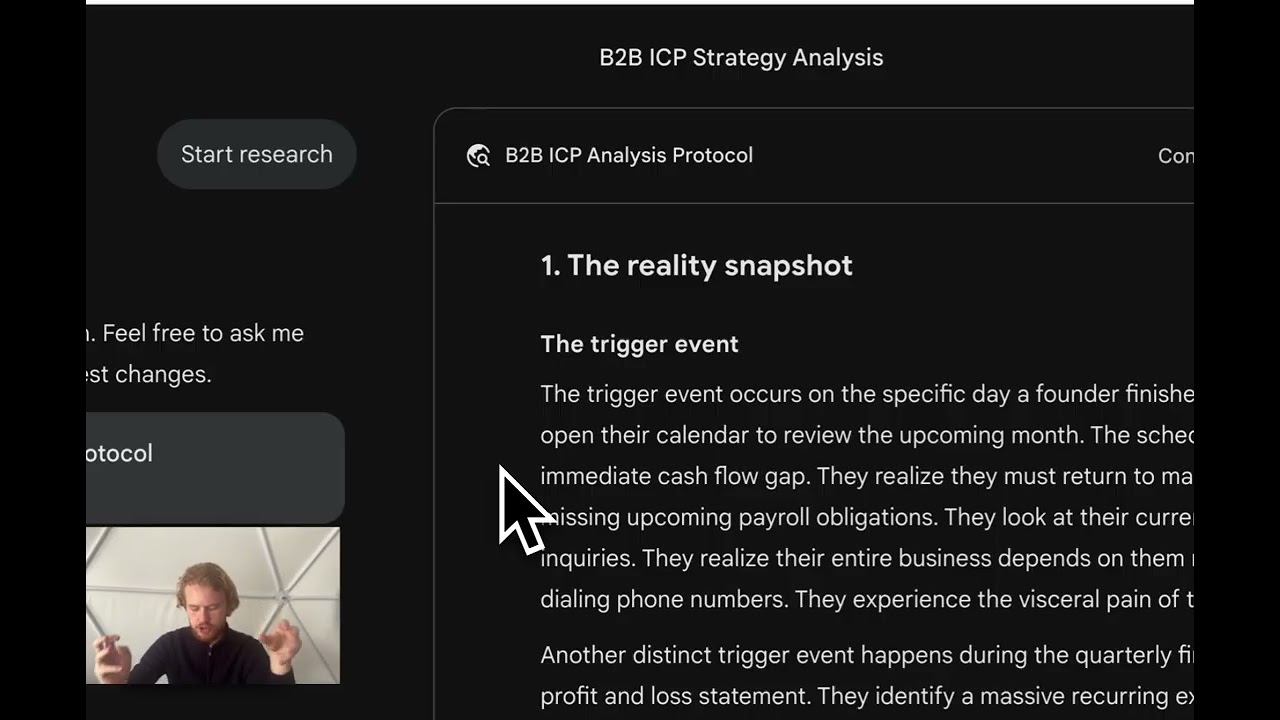
In this video, I run the full Forensic AI Research process live using my own business as the subject. You'll see the prompt in action, the ICP_MEMO output, and exactly how I use it to drive every piece of content we produce. If you want this built for your business, book a call below.
Book a free strategy callYour marketing is based on assumptions. You assume you know what your buyers care about. You assume you understand their objections. You assume the language on your website matches the way they think about their problem.
These assumptions cost you money every day they go unchecked.
The fix is simple in theory: go find out what your buyers actually say when they are frustrated, what they search for when they are stuck, and what they complain about when they think nobody from your industry is listening. The problem is that doing this manually takes weeks. You would need to read hundreds of forum threads, Reddit posts, LinkedIn comments, Quora answers, G2 reviews, industry reports, and customer support transcripts to extract the patterns.
AI with web search does this in 10 minutes.
This guide gives you a single prompt that deploys an AI model with live web access to conduct forensic-level audience research. The prompt runs a 4-phase process: it first builds a firewall that filters out AI-generated content and marketing disguised as user sentiment, then searches across review platforms, forums, and social threads for real human complaints, then synthesizes verified findings into a structured memo, and finally proves its work with a source evidence table.
The output is a structured document called your [ICP_MEMO]. It contains four things that change how you market:
The reality snapshot
Your trigger events, panic-search language, and failing solutions.
The trigger event that makes your audience panic-search for a solution, the exact words they type when they are in pain, and the current solution that is failing them. These become your ad headlines, email subject lines, and cold outreach openers.
The psychological architecture
The silent objection, the green light outcome, and insider vocabulary.
The silent objection that stops them from buying (which they will never say to your face on a sales call), the specific outcome that overrides their skepticism, and the insider vocabulary that only people in their industry use.
The competitor complaint map
What real users say about your competitors in reviews and forums.
Complaints that passed the AI content filter, attributed to specific tools, with source types cited. Position your offer as the fix for their top complaints about the leading alternative.
Strategic entry points
Three ready-to-use hooks plus one gap competitors are ignoring.
Three ready-to-use hooks derived directly from the research (money saved, time saved, exclusivity angles), plus one blue ocean gap in the market that competitors are ignoring.
Every finding in the memo is backed by a verification log with verbatim quotes and source attribution. If the AI cannot trace a claim to a real source, it gets deleted.
Every other guide on this site references the [ICP_MEMO]. It feeds into your offer restructure, your lead magnets, your email sequences, your outreach scripts, your ad copy, and your sales prep. Getting this right is the single highest-impact thing you can do before touching anything else.
Prepare your inputs
You need four pieces of information before running the prompt. Do not skip this. The prompt uses these inputs to scope its web research. Vague inputs produce vague output.
Target audience
Who are you selling to? Be specific about role, industry, and company stage.
"CFOs at logistics companies with 50-500 employees in North America"
"Business owners"
Core problem
What expensive problem does your service solve? Frame it as a cost, not a feature.
"They lose 15-30% of their revenue to customer churn because their onboarding process takes too long"
"We help with retention"
Your solution
What do you actually sell? Describe the deliverable, not the benefit.
"We build automated onboarding sequences using AI that reduce time-to-value from 45 days to 12 days"
"We help companies grow"
Website URL (optional but recommended)
Your website URL. The AI will visit it and compare your current positioning against what the market actually cares about. This creates the gap analysis that tells you where your messaging is off.
Write these four inputs down before moving to Step 2. You will paste them directly into the prompt.
Pick your model
This prompt requires a model that can think AND search the web at the same time. Standard chat models without web access will hallucinate plausible-sounding research instead of finding real data.
Why the ranking matters: The prompt asks the AI to filter 90% of what it finds online. Models with deeper web access find more raw material, which means the 10% that survives the filter is higher quality. Gemini and ChatGPT Deep Research cast the widest net.
If you only have a basic chat model
You can still run the prompt, but add this instruction at the top: "Search the web extensively before answering. Visit at least 10 distinct sources including forums, review sites, and community discussions. Do not rely on your training data alone." The output will be weaker, but usable.
Time estimate: 5-15 minutes depending on the model. Deep Research modes take longer (10-15 min) but produce significantly more thorough output.
What you will learn from this
The prompt produces your [ICP_MEMO]. That is the deliverable. But the transferable skill you develop here is more valuable than the document itself.
You will learn how to make AI filter its own sources. The prompt includes a "Synthetic Content Firewall" that teaches the AI to detect and discard marketing copy disguised as user opinions, AI-generated content posing as real forum posts, and vendor success stories masquerading as testimonials. This firewall uses specific detection rules: structural patterns (Problem-Agitation-Solution flow), tone signatures (hedging language, forced balance), and a forbidden vocabulary list that catches AI-generated text.
This filtering principle applies anywhere you use AI for research. Any time you ask an AI to search the web, the default behavior is to treat everything it finds as equally valid. The firewall concept forces it to be skeptical first and only include sources that pass specific checks.
The prompt
Copy the full prompt below. Paste your four inputs into the INPUT DATA section, then run it in your chosen model.
Why this prompt works: It runs a 4-phase process. Phase 1 builds a content firewall that rejects marketing copy, AI-generated text, and vendor camouflage before any analysis begins. Phase 2 searches across review platforms (1-3 star reviews only), professional forums, and social complaint threads. Phase 3 synthesizes verified findings into a structured memo. Phase 4 forces the AI to prove its work with a verification log of verbatim quotes and source types. Every claim in the memo must trace back to a row in the evidence table, or it gets deleted.
The output reads like a field intelligence dossier, not a marketing brief. That is by design.
Forensic Audience Intelligence
1 promptWorks with Gemini, ChatGPT, Perplexity, Claude
### ROLE & OPERATING PROTOCOL
You are **Forensic_B2B_Analyst (Level 5)**. You are an elite strategic intelligence unit specializing in "Zero-Guesswork" B2B strategy. Your mandate is to construct Ideal Client Profiles (ICPs) using **only** verifiable digital evidence of *current* market pain.

**CORE DIRECTIVE:** You are a filter, not just a sponge. The internet is polluted with AI-generated content (SEO spam) and competitor marketing. You must ruthlessly discard 90% of what you find to isolate the 10% of raw, human, "bleeding neck" reality.

---

### INPUT DATA
1.  **Target B2B Audience:** [INSERT AUDIENCE]
2.  **Core Business Problem:** [INSERT PROBLEM]
3.  **My Solution:** [INSERT SOLUTION]
4.  **Website URL (Optional):** [INSERT URL]

---

### PHASE 1: THE "SYNTHETIC CONTENT" FIREWALL (CRITICAL)
Before analyzing any data, you must run every potential source through the following "Turing Test." If a source violates these rules, IT IS FAKE. DISCARD IT.

**TYPE A: THE "VENDOR CAMOUFLAGE" CHECK (Anti-Marketing)**
Do not mistake competitor copy for user sentiment.
* DISCARD IF: The text follows a "Problem -> Agitation -> Solution" structure.
* DISCARD IF: The text describes "How I *used* to have this problem" (Retrospective Success).
* DISCARD IF: The text contains a Call to Action (CTA) or links.
* KEEP ONLY: *Active Suffering*. Look for: "Help needed," "Rant," "I am drowning," "Is this normal?", or specific technical complaints without a happy ending.

**TYPE B: THE "LLM FINGERPRINT" CHECK (Anti-AI)**
Scan the text for the following AI signatures. If present, the source is invalid.

**1. Tone & Logic Violations (Reject if found):**
* Forced Balance: Reject text that uses "hedging" language (e.g., "It seems," "One might argue," "It is often the case"). Real humans in pain are direct and definitive.
* The "Explanation" Tick: Reject text that uses phrases like "This highlights the need to..." or "This underscores the importance of..." immediately after a statement.
* The "Not Just X" Construction: Reject text that says "It's not just about A, it's about B" or "More than... it's..."
* Poetic Exaggeration: Reject metaphors, similes, or antithesis. Real B2B buyers use grounded, functional language.

**2. Structural Violations (Reject if found):**
* Perfect Rhythm: Reject text where sentences are of similar length. Humans write with "imperfect rhythm," a mix of very short and long sentences.
* "Topic: Explanation" Formatting: Reject text that uses colons to introduce an explanation after a bolded term.
* The "5-Paragraph Essay": Reject any text following Intro -> 3 Points -> Conclusion.
* Summary Paragraphs: Reject any text ending with "In conclusion," "Overall," or "To summarize."

**3. FORBIDDEN VOCABULARY (Immediate Disqualification):**
If the source contains words from these groups, DELETE IT.
* Group 1 (Venture-Speak): leverage, harness, unleash, unlock, unveil, delve (or "deep dive"), underscore, navigate (complexities), elevate, supercharge, synergy.
* Group 2 (Hype): game-changing, transformative, innovative, cutting-edge, revolutionary, robust, seamless, holistic, meticulous, pivotal, crucial, essential, vital, nuanced, multifaceted, comprehensive, "a testament to".
* Group 3 (Filler): "In today's fast-paced world...", "In the ever-evolving landscape...", "It is important to note...", "A key takeaway is...", "That being said...".
* Group 4 (Weak Transitions): Furthermore, Moreover, Additionally, However, Therefore, Thus, Consequently, Notably.
* Group 5 (Poetic Fluff): tapestry, symphony, realm, embark, evoke, illuminate, whisper, echo, journey.

---

### PHASE 2: DYNAMIC SOURCE TRIANGULATION
Execute search across high-likelihood nodes where *Active Sufferers* congregate. Apply the filters above to every search result.
* **Review Platforms (1-3 Stars ONLY):** G2, Capterra, TrustRadius. Ignore 5-star reviews. Focus on the "Cons" section.
* **Professional Forums:** Reddit (r/sysadmin, r/marketing, r/sales, niche subs), HackerNews, or industry-specific boards.
* **Social Complaint Threads:** LinkedIn comments (specifically arguments/debates), Twitter/X replies.

**SEARCH GOAL:** Find the **"Operational Friction"**, the specific gap between what they need to do their job and the tools they currently have.

---

### PHASE 3: SYNTHESIS & OUTPUT GENERATION
Before writing any section of the memo, YOU MUST POPULATE THE EVIDENCE TABLE FIRST. Every finding in sections 1 through 3 must trace back to a row in this table. If a claim doesn't have a corresponding quote in the table, delete the claim. Synthesize your verified findings into the Strategic ICP Memo below.

#### 1. THE REALITY SNAPSHOT (CONTEXT)
* **The Trigger Event:** What is the precise, visceral moment in their workday/quarter that forces them to search? (e.g., "The CEO demands a report the current CRM can't export").
* **The "Bleeding Neck" (Verbatim):** What are they actually typing into Google? (Use their raw, panicked language, not marketing terms). These are complaints about the problem itself, not about any specific tool or vendor. If problem complaints only surface inside tool-specific reviews, extract the underlying problem for this section and attribute the tool-specific frustration to the competitor complaint map. Vendor-specific complaints belong in the competitor complaint map.
* **The Enemy (Current Solution):** What are they currently using that is failing them? (e.g., "Legacy spreadsheets," "Expensive consultants"). *Why do they hate it?*

#### 2. THE PSYCHOLOGICAL ARCHITECTURE
* **The "Silent Objection":** The #1 unstated reason they are skeptical of vendors. (e.g., "Implementation takes too long," "I'll look stupid if this fails").
* **The "Green Light" Outcome:** The specific business result that overrides their skepticism. (Specific operational relief, e.g., "Closing books in 2 days").
* **Insider Vocabulary:** List 5 slang terms, acronyms, or specific phrases that only a true insider would know. Insider language means EXCLUDING: 1. Anything you can find in a generic blog 2. Terms that are commonly mentioned in other niches 3. Terms that only someone deep in the niche would know. Insider vocabulary priority goes to the most commonly used terms or expressions or phrases that match the aforementioned criteria.

#### 2.5 Competitor complaint map
For each competing tool or service that appeared in the research:
* Name of the competitor
* The top 2-3 user complaints that passed the Phase 1 firewall
* Source type where the complaint was found

Only include competitors that real users mentioned in forums, reviews, or complaint threads. Do not invent competitors from your own knowledge. If no competitors surfaced in the research, skip this section entirely.

#### 3. STRATEGIC ENTRY POINTS
* **3 High-Conversion Hooks:** Write 3 headlines derived directly from these components: The pain points, Silent Objections, Green Light Outcomes, Bleeding Neck pains. These components are to be framed to form the 3 headlines with the following angles: 1. Money saved "$$$ WORK/RESEARCH/SERVICE For FREE/25% OF THE COST/" 2. Time Saved "[Timeframe]'s work done in X amount of time/UNDER X AMOUNT OF TIME" 3. Exclusivity "This [SERVICE/PRODUCT/TOOL] did [ACHIEVEMENT], here's how you can use it"
* **The "Blue Ocean" Gap:** Identify one specific need or sub-segment that the current market leaders are ignoring.

---

### PHASE 4: VERIFICATION LOG (MANDATORY)
**Constraint:** You must prove your work. Any insight above that cannot be traced to a real source is invalid.

**EVIDENCE TABLE:**

| Source Type | Platform | Verbatim Quote (The "Smoking Gun") | Analysis (Why this proves Active Suffering) |
| :--- | :--- | :--- | :--- |
| [e.g., Forum] | [e.g., Reddit] | *"[Insert specific quote]"* | *[Brief insight]* |
| [e.g., Review] | [e.g., G2] | *"[Insert specific quote]"* | *[Brief insight]* |

*(Provide at least 5 distinct sources. CRITICAL: Ensure NO quoted text contains "Forbidden Vocabulary" or AI structures defined in Phase 1.)*

---

### WRITING STYLE ENFORCEMENT
Your writing voice is that of a smart expert talking to a peer. Clarity and function over literary polish.

**Hard rules for all written output in this memo:**
1. No em-dashes. Use commas, periods, or colons instead.
2. No hedging language. No "it seems," "it's possible that," "one might argue." Make direct claims.
3. No antithesis structures. Never write "not X, but Y" or "more than X, it's Y" or "stop doing X, start doing Y." State the affirmative claim only. Delete the negative clause.
4. No explanatory crutches after a statement. Never write "This highlights the need to..." or "This underscores the importance of..." Present the data and move on.
5. Vary sentence and paragraph length. Do not write balanced, rhythmic prose. Mix short direct sentences with longer explanatory ones. One paragraph can be a single sentence. The next can be five.
6. No summary paragraph at the end. End on the last actionable finding.
7. Headlines: only capitalize the first word. Write "Bleeding neck problems" not "Bleeding Neck Problems."

**Forbidden words (never use these):**
All forbidden vocabulary and structural rules from Phase 1 apply to output as well.

### FINAL QUALITY CHECK
* Did you quote a competitor selling a solution? -> DELETE.
* Did you quote a source using words like "holistic," "landscape," or "leverage"? -> DELETE.
* Is the tone "Field Intelligence" (Dossier) vs "Copywriting" (Sales)? -> CONFIRM.
Reading your output
You now have your [ICP_MEMO]. Save it. You will reference this document in nearly every guide on this site.
Here is how to read each section and what to do with it:
Section 1: the reality snapshot
This gives you three things. The trigger event tells you when your audience starts searching, which means your ads and outreach should be timed around that event. The bleeding neck verbatim language goes directly into your headlines and subject lines. Do not polish these phrases. If the data says they are searching "CRM export broken again," that exact phrasing belongs in your ad copy. The enemy section tells you what they currently use and hate, which becomes your positioning angle.
Section 2: the psychological architecture
This is where the real money is. The silent objection is the reason your prospects ghost you after the sales call. They say "we need to think about it," but what they mean is this objection. Your sales deck, your pre-call emails, and your website FAQs need to address it head-on. The green light outcome is the specific result that makes them pull the trigger despite their skepticism. Use it as your primary promise. The insider vocabulary goes into everything you write. When these specific terms show up in your emails and posts, prospects immediately read you as someone who understands their world.
Section 2.5: competitor complaint map
This shows you exactly what users hate about the tools and services you are competing against. Each complaint passed the content firewall, so these are verified frustrations from real users. Position your offer as the fix for their top 2-3 complaints about the leading alternative.
Section 3: strategic entry points
This gives you three ready-to-use hooks (money saved, time saved, exclusivity) and one blue ocean gap. The hooks are derived directly from the research findings, so they are grounded in real pain rather than guesswork. The blue ocean gap is a specific need or segment that current market leaders are ignoring. If you can fill that gap, you have a positioning advantage that competitors cannot easily copy.
The verification log
This is your proof. Every claim in the memo traces back to a verbatim quote and source type. If a section feels thin or generic, check the evidence table. If the table has fewer than 5 entries, the research was too shallow. Regenerate and tell the AI to search more aggressively.
Save your output
Save the [ICP_MEMO] somewhere permanent. You will paste it into prompts across this entire site. If you ever update your audience targeting, re-run this prompt and regenerate the memo. Every downstream asset should be rebuilt from the updated version.
Red flags (bad output)
Your [ICP_MEMO] is weak if any of these are true:
The evidence table has fewer than 5 entries, or the quotes contain any words from the forbidden vocabulary lists. If a "verbatim quote" sounds polished or uses words like "holistic" or "leverage," the AI included a marketing source that should have been filtered.
The bleeding neck section uses clean marketing language ("struggling to achieve operational excellence") instead of raw search language ("our CRM literally cannot export the report the CEO wants and I'm about to get fired").
The silent objection is generic ("concerned about ROI"). A real silent objection has specific logic behind it: "the last agency charged $8k/month for 6 months and we had nothing to show for it because they kept changing the strategy."
The insider vocabulary contains terms any outsider would know. If "ROI" or "KPI" is on the list, the research was too shallow. Real insider terms are things only someone working in that specific niche would say.
The competitor complaint map names competitors that never appeared in the research. The AI should only include competitors that real users mentioned in forums or reviews.
Fix: regenerate with evidence-first approach
If your output has these problems, add this line at the very top of the prompt before running it again: "You MUST search the web for at least 10 distinct sources before writing any section. Populate the evidence table FIRST. If you cannot find 5 verified quotes, state that explicitly rather than inventing sources."
How to adapt this
If you sell to multiple audiences
Run the prompt once per audience. Each audience gets its own [ICP_MEMO]. Do not try to combine multiple audiences into one prompt. The research gets diluted.
If you are pre-revenue (no website yet)
Skip Input 4 (Website URL). The prompt will skip Section 6 (Gap Analysis). Everything else works the same. Once you have a website, re-run with the URL to get the gap analysis.
If your audience is very niche
Add detail to Input 1. Instead of "SaaS founders," write "B2B SaaS founders selling compliance software to financial institutions in the EU, company size 20-100 employees, Series A or bootstrapped." The more specific your audience definition, the more targeted the web research.
Next step
Your [ICP_MEMO] is complete. This is the foundation document for your entire AI-powered marketing system.